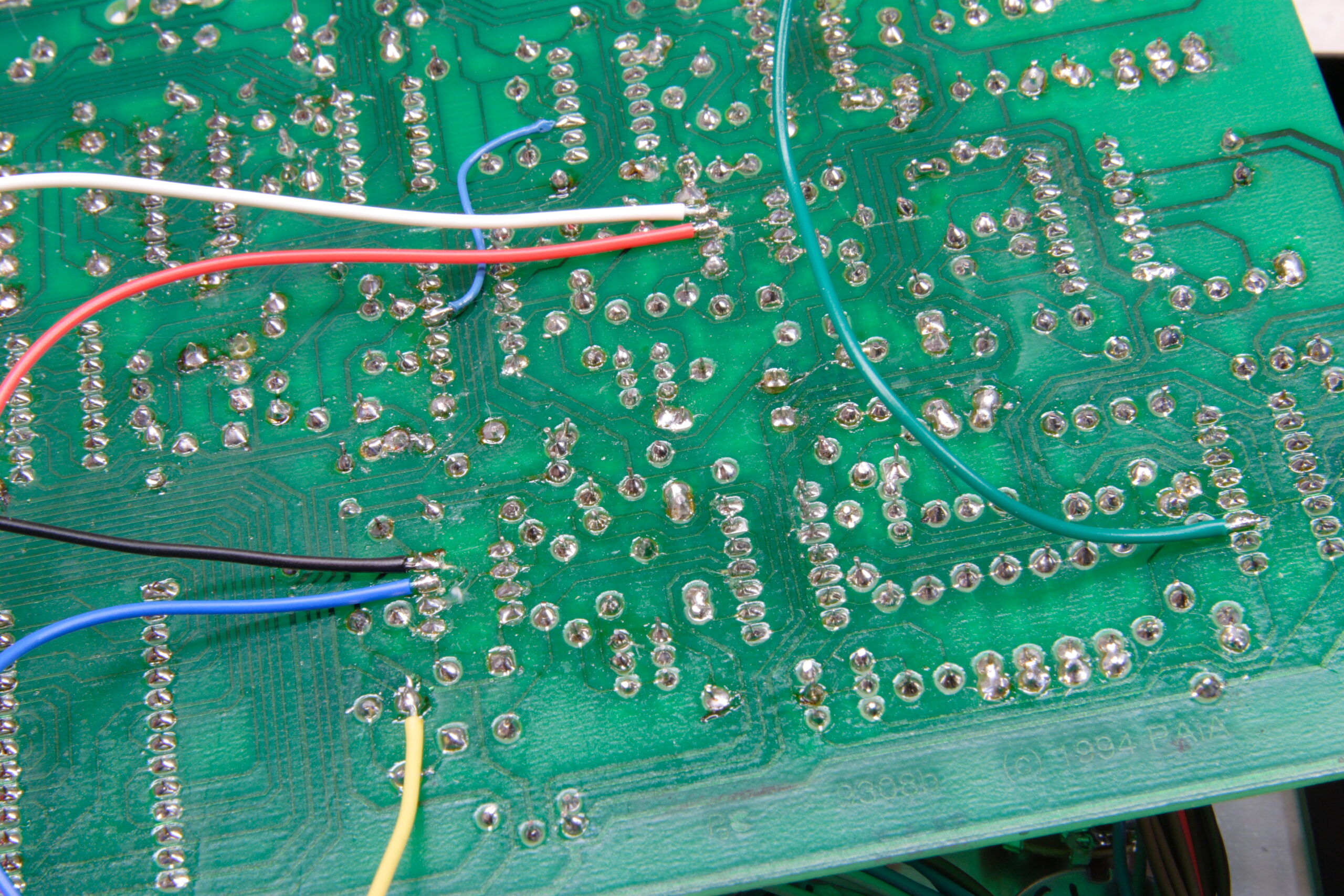
nuxx.net
Making, baking, and (un-)breaking things in Southeast Michigan.

Category: making things

x0xb0x Panel Issue


Error in my x0xb0x Panel Overlays

Well, this is good. I’ve been in touch with MaverickLabels.com about the error in the printing of the x0xb0x panel overlays. I’ve been told that the reprinted panels will either ship today or tomorrow. This makes me quite happy, because hopefully I’ll have the synth finished by the end of the week. So, while there was a problem with the printing, that company is definitely doing a great job getting it sorted out. I feel a lot better about this all now.

Now, just two more synths to finish… Well, that’s before the 9090 project (and this will be a HUGE project) begins. More on these other two later.

electronicsmaking thingsmoved from livejournal

x0xb0x Panel Overlays

[This is a cross-post from here in the ladyada.net Forums, redone in HTML instead of BBCode.]

Well, that should whet people’s appetites.

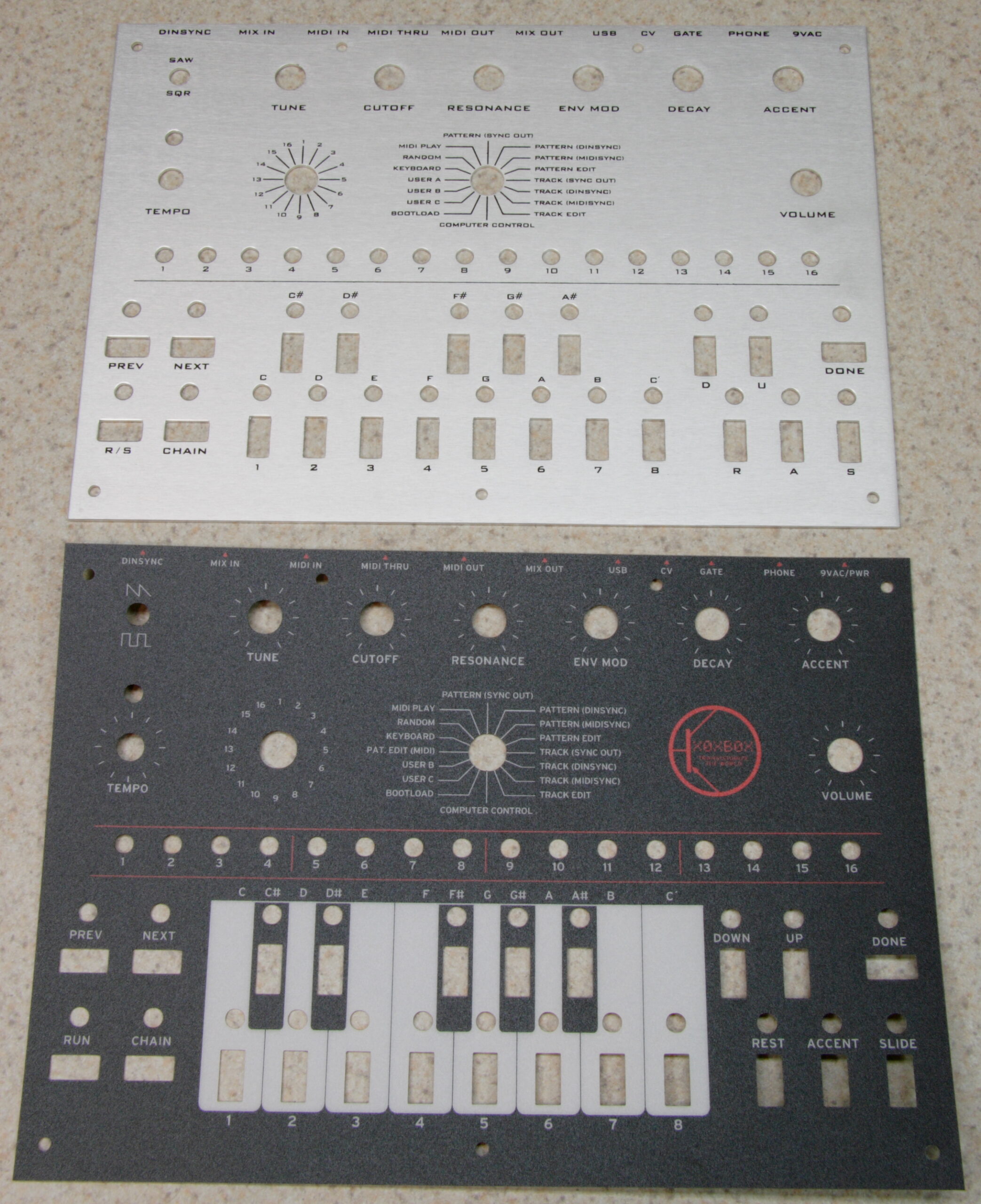
That photo above means that I’ve received the panels from MaverickLabels.com. There are both good and bad things about this…

First, the good:

– The panels look excellent. The colors are exactly what I wanted, and the print quality is outstanding.
– Everything appears to align nicely to my x0xb0x panel.

Now, the bad:

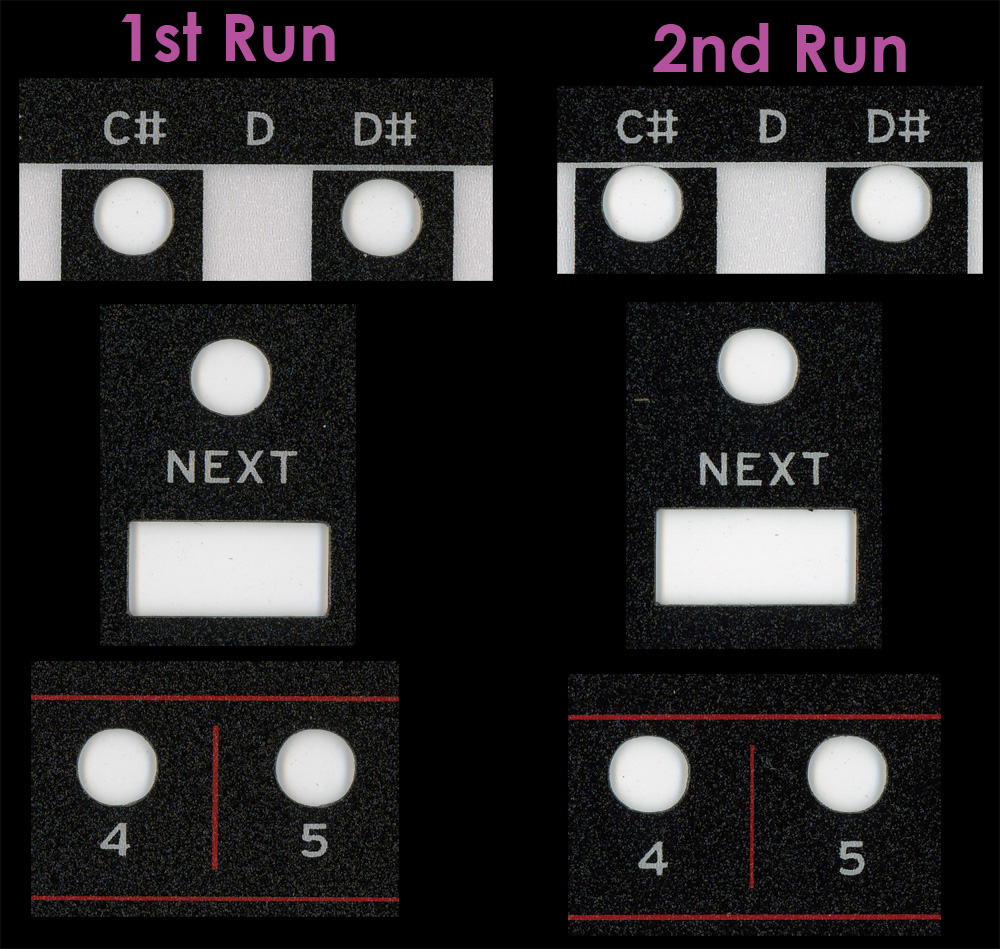
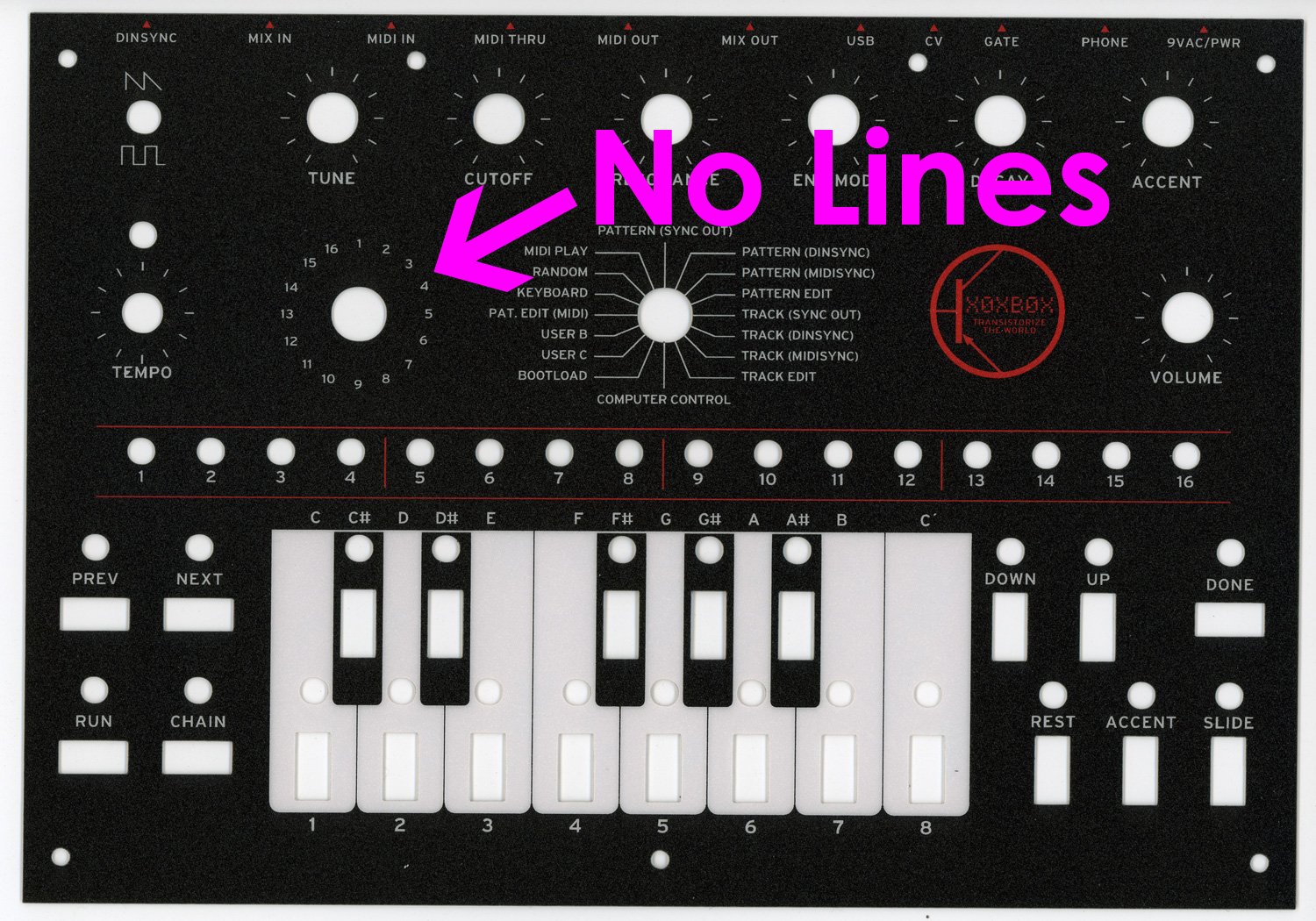
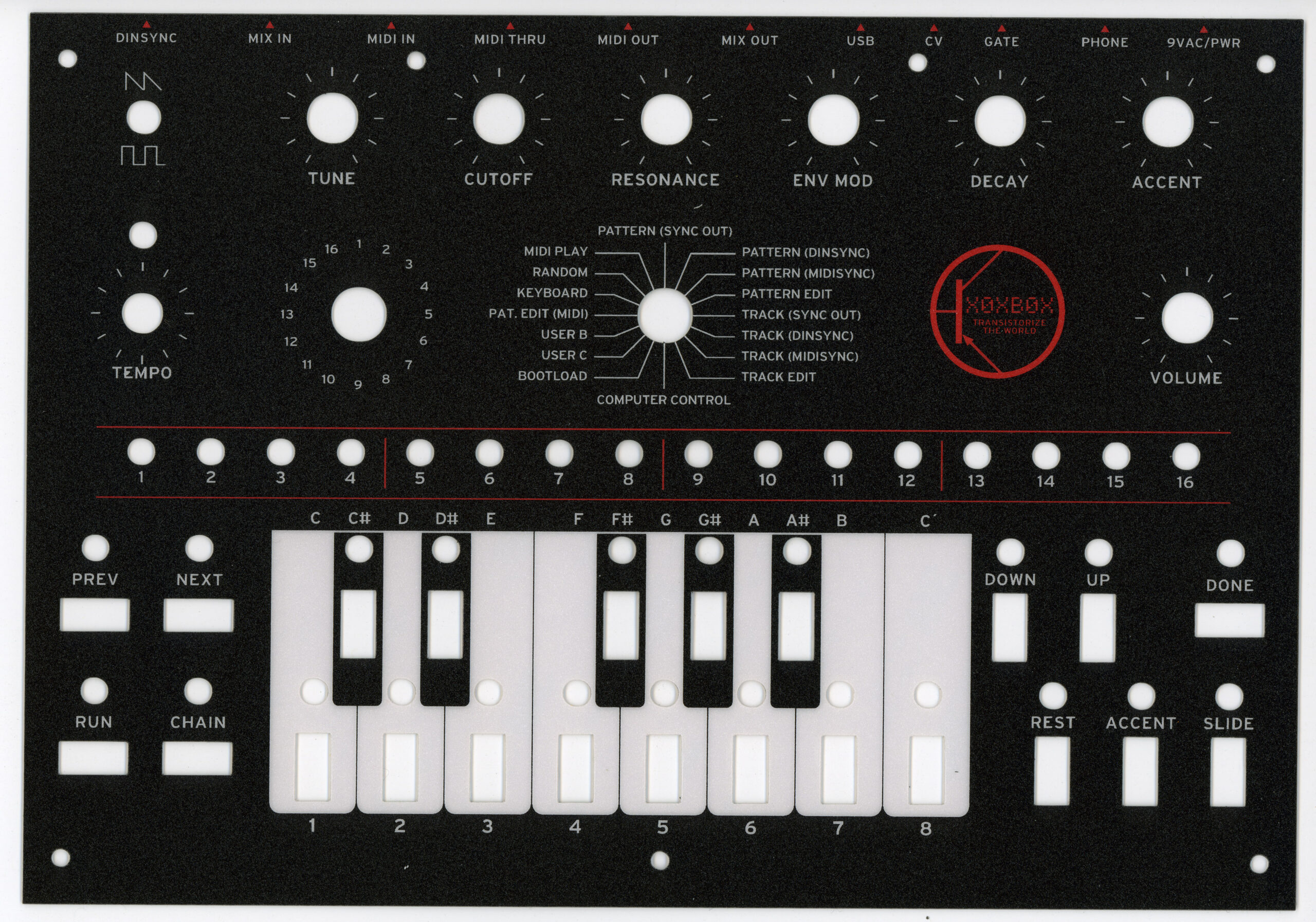
– See the image above? See how it is missing the lines from the bank indicator switch through hole to the numbers? They aren’t right.

This means that I’m not going to sell / ship them yet… MaverickLabels.com is closed until Monday, at which time I’ll be calling them and seeing what they will do to sort out the problem. I find it interesting that these lines are missing, as the digital proof which MaverickLabel.com sent has them in there.

I am hoping that they will sort out the problem and get corrected labels shipped to me quickly.

In the mean time, here’s a few more photos involving the finishing of my x0xb0x and the panel overlays:

High res scan of one of the panel overlays I received tonight to show the detail of the printing and the error. (Please note that the colors aren’t accurate, and the sparkly appearance is because of the texture of the Lexan.)
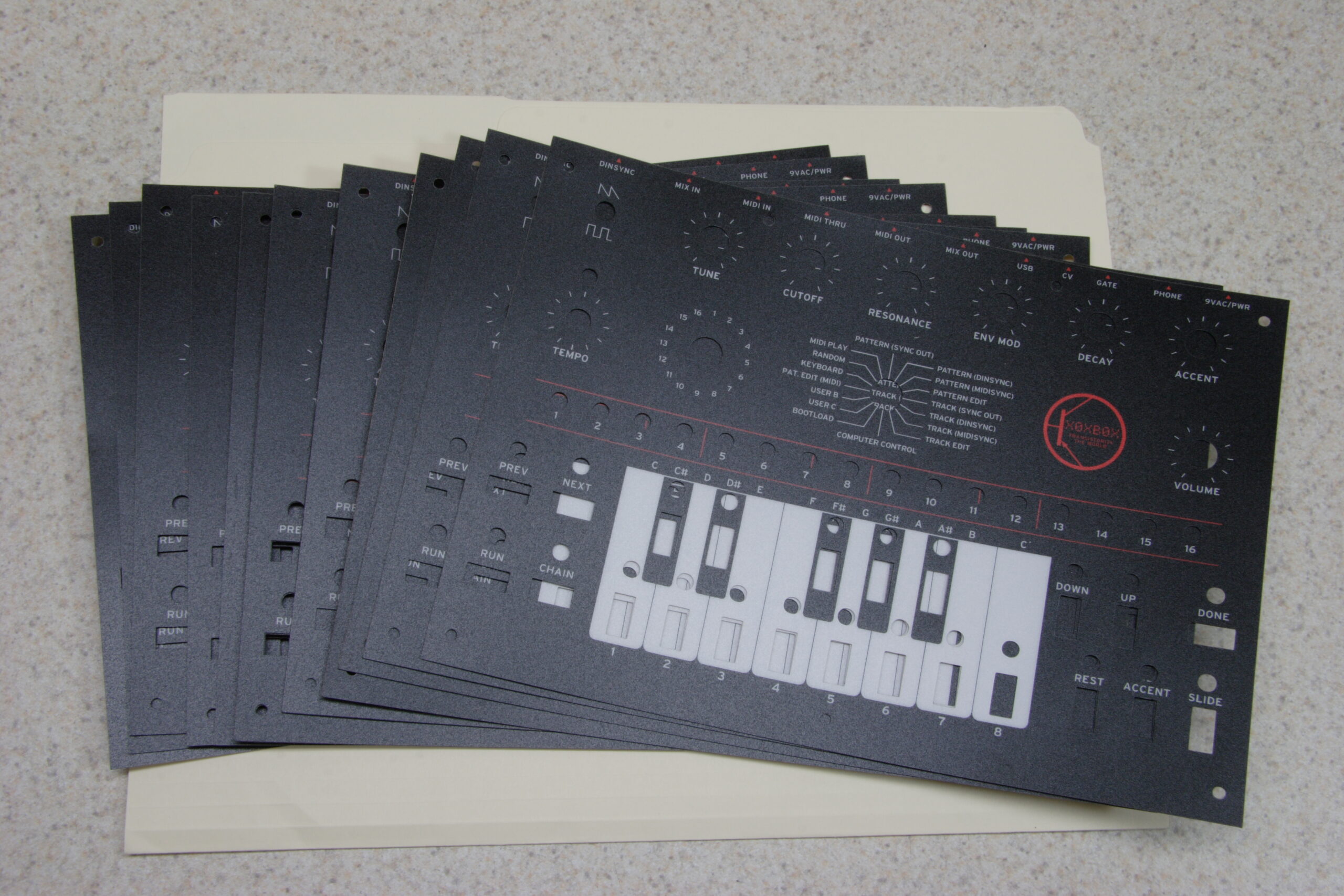
Stack of all 12 panels, not long after they were removed from the shipping package.
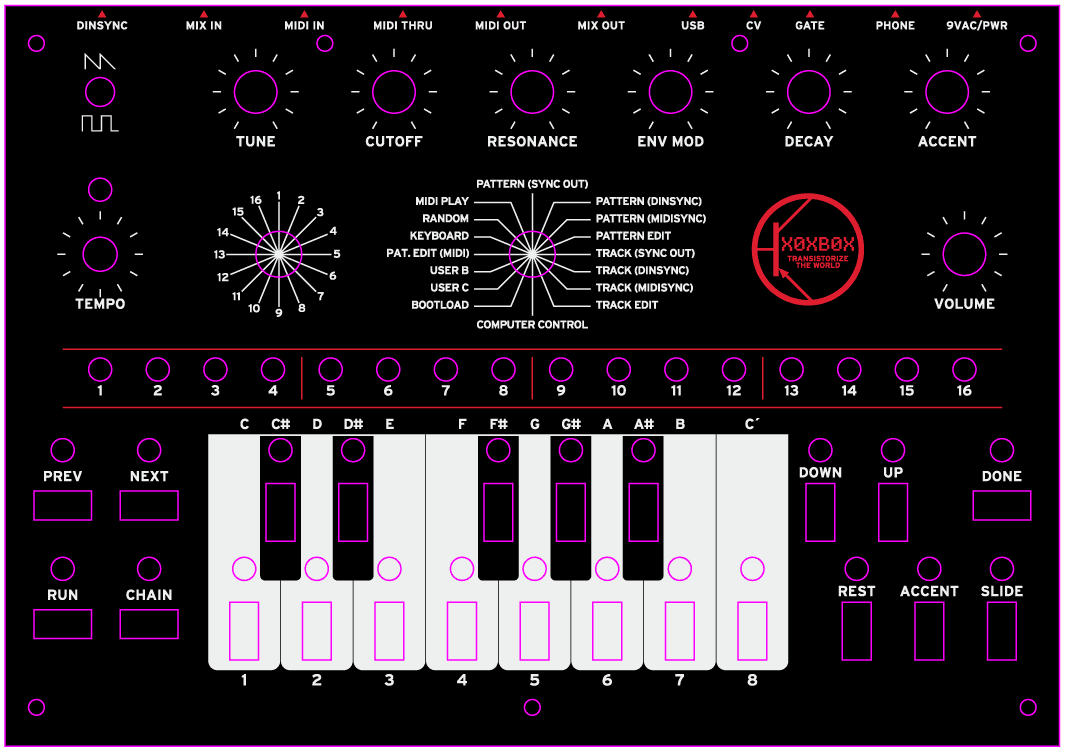
The original proof sent by MaverickLabels.com.
Glare-filled comparison of an x0xb0x panel overlay (with error) and the original x0xb0x panel.
A smaller version of the scan of the panel, with the missing lines pointed out. This was made so I could send it to MaverickLabels.com.

So, that’s that. Everything is on hold until Monday when I can talk to the Customer Care people and see what they are going to do to sort out the problem. I don’t see a problem with things getting sorted out, especially if they are willing to put a guarantee like this on their site. But, we’ll see…

Per usual, I’ll keep posting updates here.

-Steve

electronicsmaking thingsmoved from livejournal

Printed Crap Board


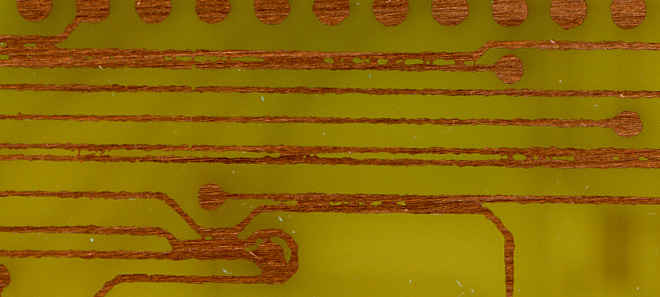
The traces are nowhere near as clear as they should be.

So, yeah. Tonight I tried to make the printed circuit board detailed in this PDF on this page for making it possible to trigger my Casio SK-1 via MIDI.

Well, I learned two lessons in doing this…

First, my technique for registering the two sides on a double-sided PCB appears to be successful.

Second, my method of laser printing the mask on vellum and exposing to fluorescent light for 10 minutes isn’t good enough for fine lines. As you can see above, something went awry and the photo resist between the lines wasn’t exposed to enough light.

I think I’m going to try an experiment with various levels of detail and a smaller single-sided PCB with a piece of laser printer transparency, just to see how well this method will work. I don’t think it’ll work out so well, but it can’t hurt to try…

If this doesn’t work, I guess I’ll have to order some special paper just for doing this kind of thing. That won’t be cheap…

Well, at least I’ve got a few more unexposed boards to play with.

electronicsmaking thingsmoved from livejournal

b0rked x0xb0x


Setting the power supply to output 5.333 VDC.
(Click for more x0xb0x construction photos…)

Well, last night I finally received my Mouser order with the parts that I was waiting for.

Hmm. Perhaps I should backtrack a bit… After finishing the electrical assembly of my x0xb0x, I found that the LEDs were way too dim. After building the Elenco XP-720K power supply (photo gallery retired), I was able to test out the LEDs with different resistors and find some appropriate ones. It turns out that a 820Ω resistor in conjunction with the LEDs worked out to be exactly what I wanted, bright enough to be seen under a bunch of lighting, but not glaring when in the dark. So, last week I desoldered all 40 resistors which tie to the LEDs, and last night I hooked in the 820Ω resistors, put the x0xb0x back together, cleaned off the flux, then got it all working.

After that installing the new resistors I went through and set everything up with the new Fluke 179 and got it all set up right. The frequency counter in it was especially handy, as it made setting the offset between octives (this synth is 1V/oct). Not long after the synth was all done being tuned, and it sounds great. Then I broke it… More on that later.

Yesterday, as a prerequisite to tuning the synth, I also finished up some work on the Elenco XP-720K (photo gallery retired) by adding heatshrink tubing to the worryingly unprotected IC leads, installing new Bourns 10-turn wirewound pots in place of the original 300° carbon ones, and new knobs from EPD (450-2016). The new knobs were needed as the shafts of the new pots are of a different design, and I also wanted some which allow for a bit finer control. While I like how they look I’m still not sure if they allow for fine enough control. We’ll see…

With the new pots, I am able to easily set the supply voltage to within a few thousandsths of a volt, and with some gentle nudging of the knob I can generally hit the exact voltage I want. Because the pots are wirewound there seems to be a limit to how fine the control I have actually is, but things are still fairly accurate. Adding a second set of wirewound pots (200Ω) as a ‘fine tuning’ control in parallel with the existing ones would help give more control, but it would require drilling more holes and… I don’t know if it is needed. Regardless, I am quite happy with the finished power supply.

So… About how I broke my x0xb0x. Well, to make a long story short, I was playing around with writing my own firmware for it, and after flashing it one of the times, it no longer worked. Details of all what happened can be read here, but the solution ended up being flashing it with alternate firmware, then going back to the original firmware, then wiping the patterns in the EEPROM. I think I had corrupted part of the EEPROM, and as the EEPROM is read as part of setting the tempo as the x0xb0x boots, I think I was making it crash on boot.

Also, I’ve found my firmware with the blinky startup sequence causes my x0xb0x to crash randomly, so that needs work. That’ll come later. Thusly, I’m just using the normal, and originally shipping, v1.04 firmware.

I think I’ll also tag some specific photos of interest here:

· The pile of LED-driving 10KΩ resistors pulled from my x0xb0x.
· Calibrating the x0xb0x’s power supply to 5.333VDC.
· Playing the x0xb0x via MIDI. As a nice surprise, a velocity over ~100 seems to trigger accent.
· The newly heatshrink tube’d IC leads in the Elenco XP-720K.
· Rear view of the Bourns 3504S-1-202 pots in the Elenco XP-720K.
· Two front views of the front of the Elenco XP-720K with the new pots and EPD 450-2016 knobs: 1 · 2

electronicsmaking thingsmoved from livejournal

PAiA FatMan Subharmonic Generator


My first hand-designed and photo resist etched PCB.
(Click for full 600dpi scan…)

Well, that went well. What you see above is my first hand-etched PCB, and is also a layout I did myself. That right there is the PCB I’m going to add to the PAiA FatMan which I am rebuilding, and provided I interpreted the schematic for the part correctly, that should add two extra octaves of harmony to this synth, giving it some nice, thundering bass.

I should mention that the traces are a shiny silver in person, although I’m not completely sure that I tinned them enough. Also, yes, one of the pads on the left side isn’t quite right. I’m not sure what is with it, as it appears to just be matte in person. It doesn’t matter too much, though, as the reason I made two is to both use up space on the board (it’s 2″ x 4″ and my design was nowhere near that large) and so that if one got screwed up, there would be a second.

So, I guess at this point I’m ready to try etching the double sided board for adding MIDI to my Casio SK-1. I would have done it tonight, but it is getting a bit late to start everything over from scratch…

Anyway, yeah. This makes me happy. Hopefully tomorrow I’ll be getting the order from Mouser which will contain the new resistors for my x0xb0x (photo gallery retired), parts for the FatMan rebuild, and the new pots for the Elenco XP-720K (photo gallery retired).

Mmm… Projects…

UPDATE: Damnit. I don’t know how I didn’t notice it until just now, but there is a 90º bend in one of the traces, when I tried to do everything in… Well… Not 90º joints. Guh. I feel like an idiot, because i know this is one thing that I was trying to avoid… And I somehow missed it in all the times I stared at the printout.

Ah well, It’s only a power line, so it shouldn’t hurt anything… I still feel dumb about it, though.

electronicsmaking thingsmoved from livejournal

First Board Layout

Hey, look. It’s the first PCB layout I’ve ever done… Seems to be okay, too. The autorouter didn’t do as good of a job as it could have, but that’s okay. This isn’t what I’ll actually be producing the board from, I just wanted to be sure I had a good understanding of how to do it.

Oh, and that board up above there will be for this subharmonic generator for the PAiA FatMan, the two octive version. It’ll be connected to the board and front panel via flying wires. (Yes, there will be photos once I actually do it… The parts are on order.)

And yes, that should say “Subharmonic Generator” in there. I’ll fix it later.

electronicsmaking thingsmoved from livejournal

PAiA FatMan Plus Panel Idea

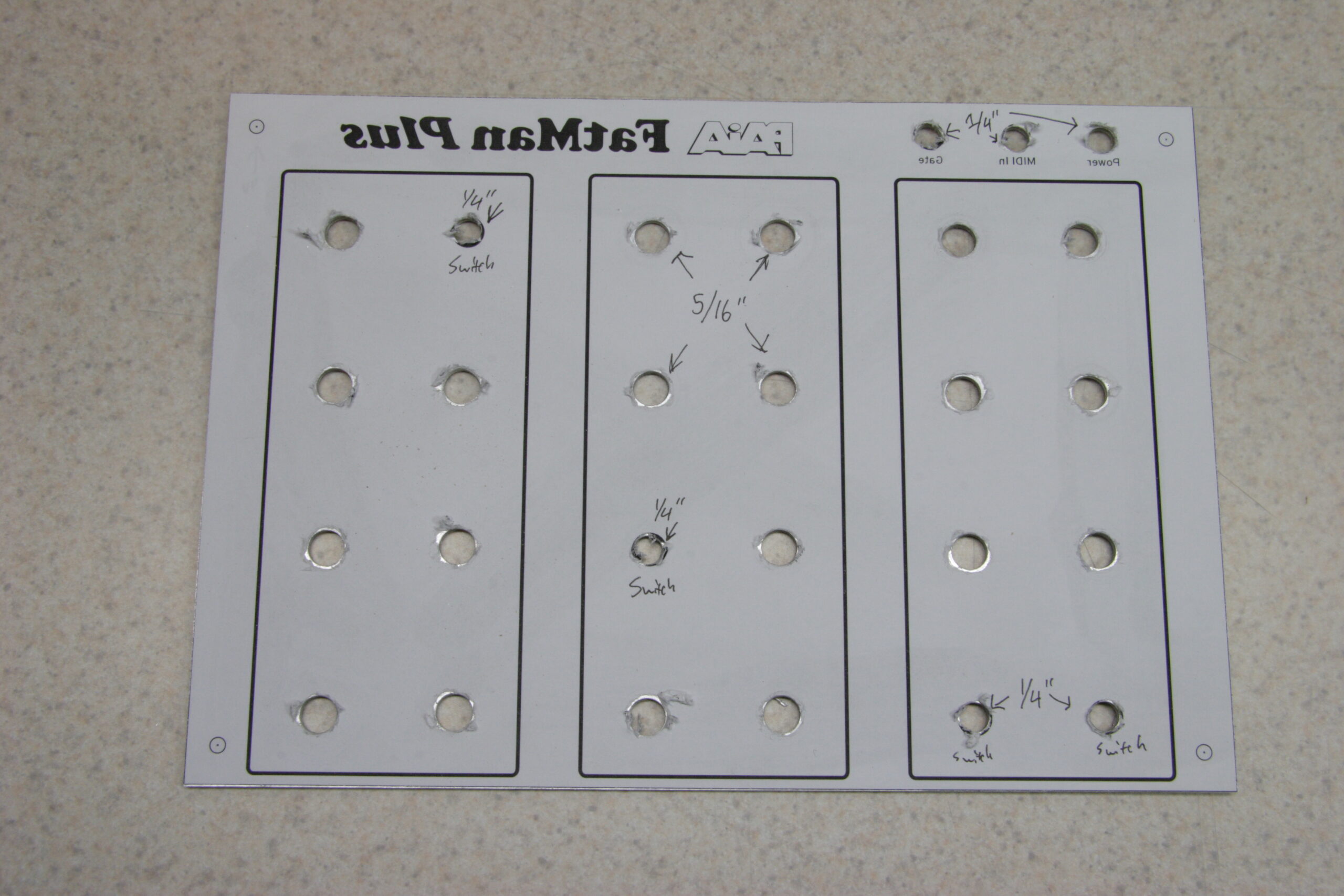
Up above there is the rough idea I just threw together for the front panel of the PAiA FatMan which I’m rebuilding. I am going to be putting it in a new enclosure and adding some extra stuff to it, so I need to design a new panel.

I’m curious if those of you who are familiar with using synths what you think of this… I tried to somewhat follow the original FatMan desktop enclosure layout, adding the mods (subharmonic generator and VCO hard sync) where appropriate.

No, things aren’t lined up yet, labels aren’t in there appropriate places, and there are no knob position indicators… I’m just trying to get some layout ideas. Also, the three vertical columns of controls will be sized the same and properly centered. Also, the groupings will be labeled similarly to how the VCF one is. Oh, and the whole thing will likely be in white lines and text on black, similar to the x0xb0x. It’s just easier to start designing this way.

So, what do you think? What would you change?

Thanks!

electronicsmaking thingsmoved from livejournalmusic

Elenco XP-720K


Inside of the completed Elenco XP-720K
(Click for more…)

Yesterday I received the Elenco XP-720K kit which I ordered last week from KITS USA. Their price of $44.95 for it was far cheaper than most other places, so I was able to get it with a few lead sets (banana plug to alligator clip, banana plug, and micro connector) for around US$60 shipped. Not a bad price at all for such a well made kit power supply, I don’t think.

Anyway, building it went rather well, and the biggest problem I had with it probably revolved around the detail of the manual. The problem was not with too little detail, but actually too much. It seems that this kit has its manual designed to be used in school for learning purposes, so it goes rather step by step of hooking up every part. It wasn’t a big issue to deal with, though. The nice thing about it being this sort of kit is that the function of the entire supply is clearly detailed in the back of the manual, wholly explaining how a rectifier works, what each part does in the circuit, etc.

The biggest problem I have with the kit is how the leads connect to the heatsink’d ICs and that the front mounted pots aren’t fine enough for my needs, but it should be trivial to work around this. I’ll just add another pot in series with the existing one, probably something an order of magnitude lower than the current one, and it’ll function as a ‘fine’ control. When the chassis is open for adding these fine controls, I’ll also add some heatshrink tubing around the leads on those ICs. This is just to ensure that a solid physical jolt to the chassis won’t inadvertantly cause some of the leads to touch, causing a short.

Oh, the only other complaint about it (and this isn’t much of a complaint) is that the pads on the bottom of the PCB are gigantic. While this may be appropriate for some of the larger diodes, it took quite a bit of solder to cover the pads, and it seemed overkill for the various leads. It’s possible that this kit’s educational nature may be another reason for the large pads, though. Maybe to make it easier for those with large-tipped irons or those just getting started to successfully complete the kit. Again, not much of a complaint, just something which was a bit of a frustration.

In the end, I’m quite glad I picked up this kit, and I’d have to recommend it to anyone else who needs a simple, low-cost benchtop power supply. It was easy to build, went real smoothly, gave me something to do for an evening, and it works as advertised. With the addition of some stacking banana plug cables, you can hook it up to a spare DMM and whatever you are powering at the same time, making it easy to see exactly what voltage is being sent, and change things without re-plugging anything.

Here’s some photos from my gallery showing various stages of the construction of the Elenco XP-720K (photo gallery retired):

· The Elenco XP-720K comes in a nice, simple box.
· The pile of parts which came in the box.
· The enclosure is nice, thick, enameled steel.
· Detail of the silk screen side of the PCB. No, there aren’t very many parts.
· PCB with all the parts and flying wires installed.
· Solder side of the PCB with all parts installed and flux removed.
· Chassis with all front panel connections and controls installed, transformer, and mains power connections fitted.
· ICs fitted to the heatsink, with the leads reflow soldered on. These need heatshrink tubing to isolate them.
· Looking down into the top of the Elenco XP-720K.
· My completed Elenco XP-720K power supply with the chassis closed.
· While testing the Elenco XP-720K I was able to hit 2.000VDC. This would have been easier with a fine control, which I’ll add later.

electronicsmaking thingsmoved from livejournal

x0xb0x

Well, it works. It’s untuned, uncalibrated, and wholly unfinished. But it makes synthy sounds and appears to not have any problems, except for the LEDs being rather dim.

I’ll worry about that later… For now I need to worry about the new power supply and the new DMM I’m waiting for.

electronicsmaking thingsmoved from livejournal