nuxx.net
Making, baking, and (un-)breaking things in Southeast Michigan.

Category making things

Audio Input Switch PCBs Ordered

[This is a cross-post from here at diyAudio Forums:]

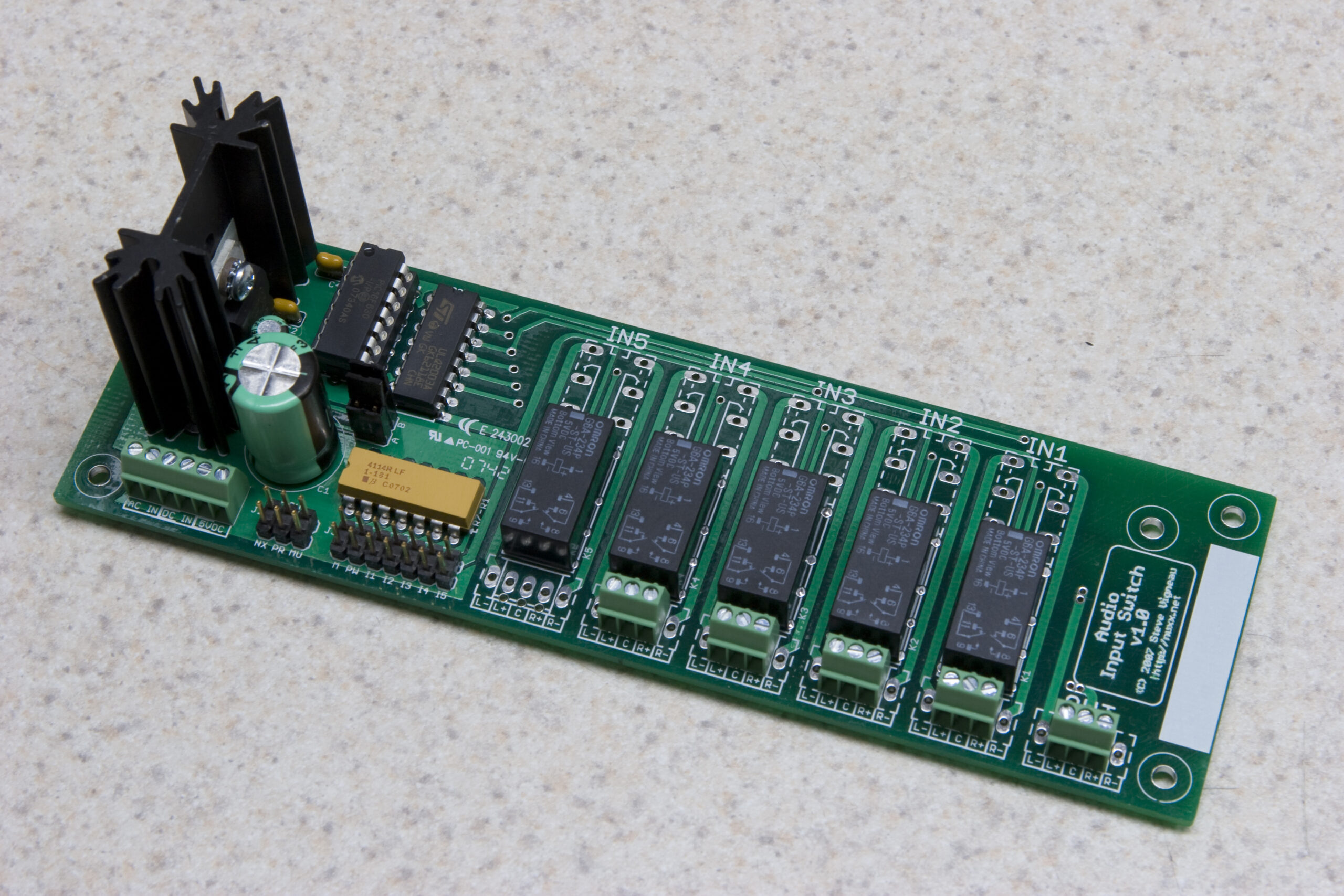
Well, the first five PCBs were ordered from PCBEX.COM a few minutes ago. The biggest changes since yesterday were moving the smoothing capacitor before the voltage regulator to 1000uF (13mm diameter, 5mm lead spacing footprint) which required a good bit of shuffling of parts in the power supply. (Some configurations, particularly those not needing to use the 5VDC output, can use a much smaller cap here. I’m recommending this value as a best-fit.) As part of this I also ended up moving all of the connectors to the front edge of the board, which I think is a rather good thing.

The boards are five-day turn, so I figure they’ll ship sometime around the end of next week. As PCBEX.COM batches their boards out to China I expect it’ll be another week or so before I have the boards.

Here’s how the part prices from Mouser breaks down:

All parts, except PCB, heatsink, relays, and audio terminals: US$10.46
5x 4PDT Omron relays and 5 place Phoenix terminals: US$57.10
5x DPDT Omron relays and 3 place Phoenix terminals: US$25.45
1″ Tall Heatsink: US$1.14
1.5″ Tall Heatsink: US$1.06

Of course, you can cut these prices down if you do things such as not fitting the boards to switch all five inputs, leave out some of the onboard power supply parts, etc.

The PCBs cost about US$16/each after shipping from PCBEX.COM. If I were purchasing for a group buy or something I imagine the price would be a good bit lower, although that obviously depends on the quantity.

So, I guess that’s about it for now… There is more info over at the main nuxx Audio Input Switch (as the device is now known) page.

One final question for everyone: Are any of you interested in purchasing some of these PCBs in a group buy?

I figure that I could probably handle doing a group buy for some folks. I’d provide a PCB and programmed PIC, and you’d just have to order the rest of the parts. Everything in there is very standard, so even if you can’t order from Mouser you shouldn’t have a problem sourcing the same (or compatible parts. I’m not in the position to offer kits or assembled boards.

Off the top of my head I’d estimate the total cost at being around $20, to cover the blank PCB, PIC, packing stuffs, PayPal fees, etc.

Anyway, that’s it for now…

electronicsmaking thingsmoved from livejournal

Ahhh!

1) I should be in bed.
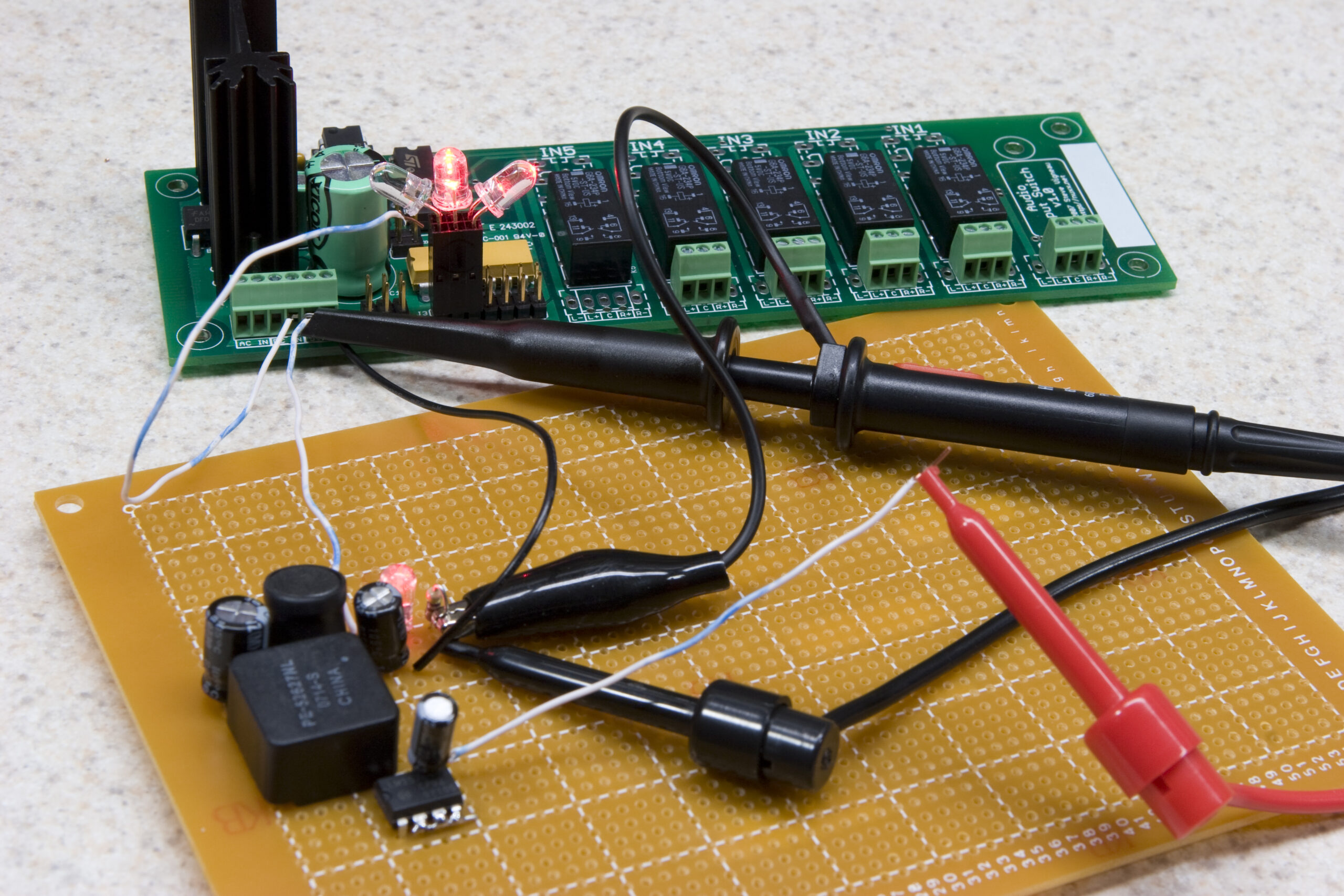
2) The vent on an electrolytic capacitor is called that for a very good reason. That said, I’m surprised how long the 470uF 25V Nichion audio cap worked for while backwards. It even somewhat worked while backwards, which is probably why I let it go for so long. Whoops!

electronicsmaking thingsmoved from livejournal

Audio Input Switch Breadboarded

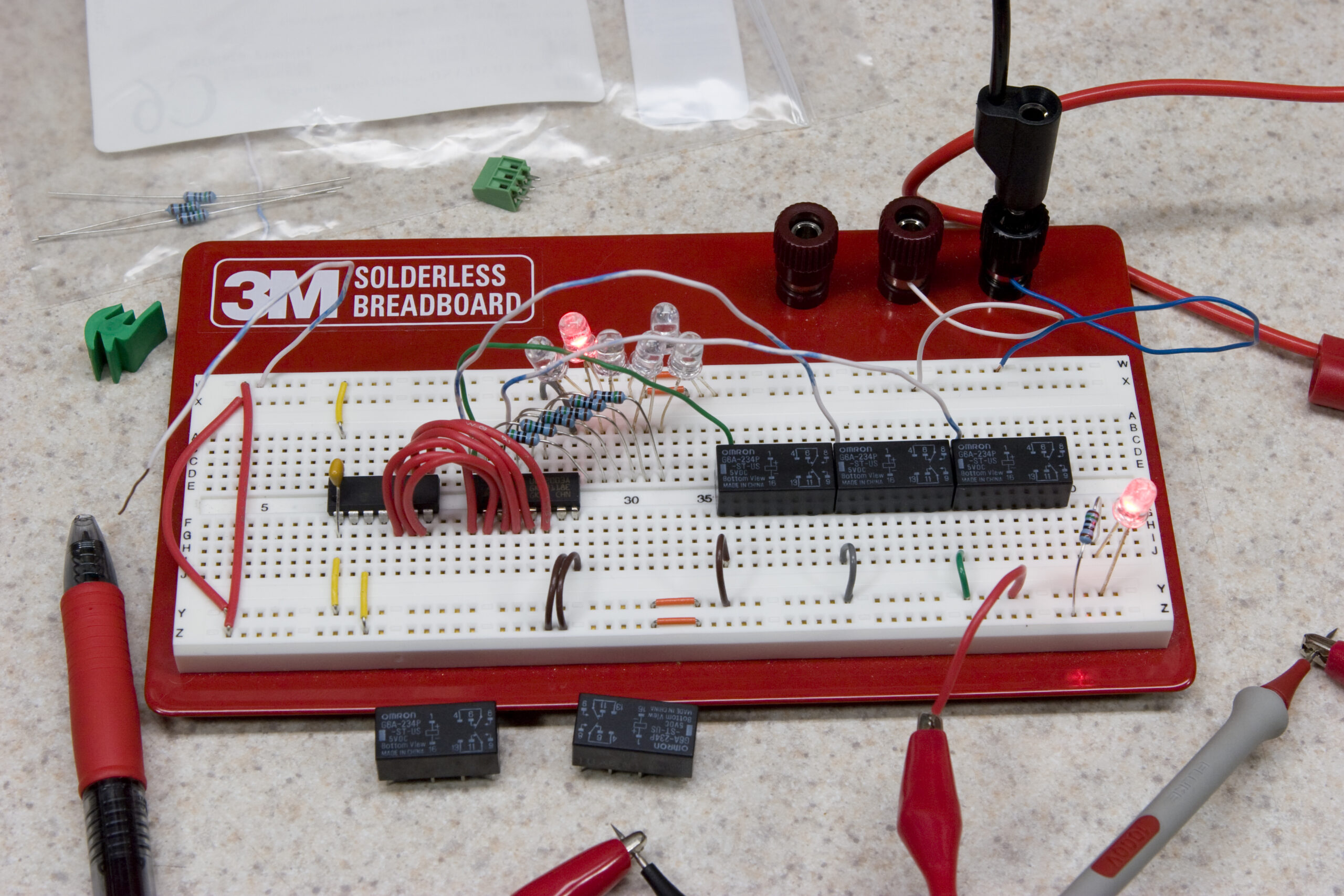
nuxx Audio Input Switch on a Breadboard

Well, that’s that. The nuxx Audio Input Switch is coming along nicely and things are working as expected. Except for not realizing that MCLR has to be externally pulled high (or disabled), causing me about half an hour of head scratching, the software has worked as hoped for.

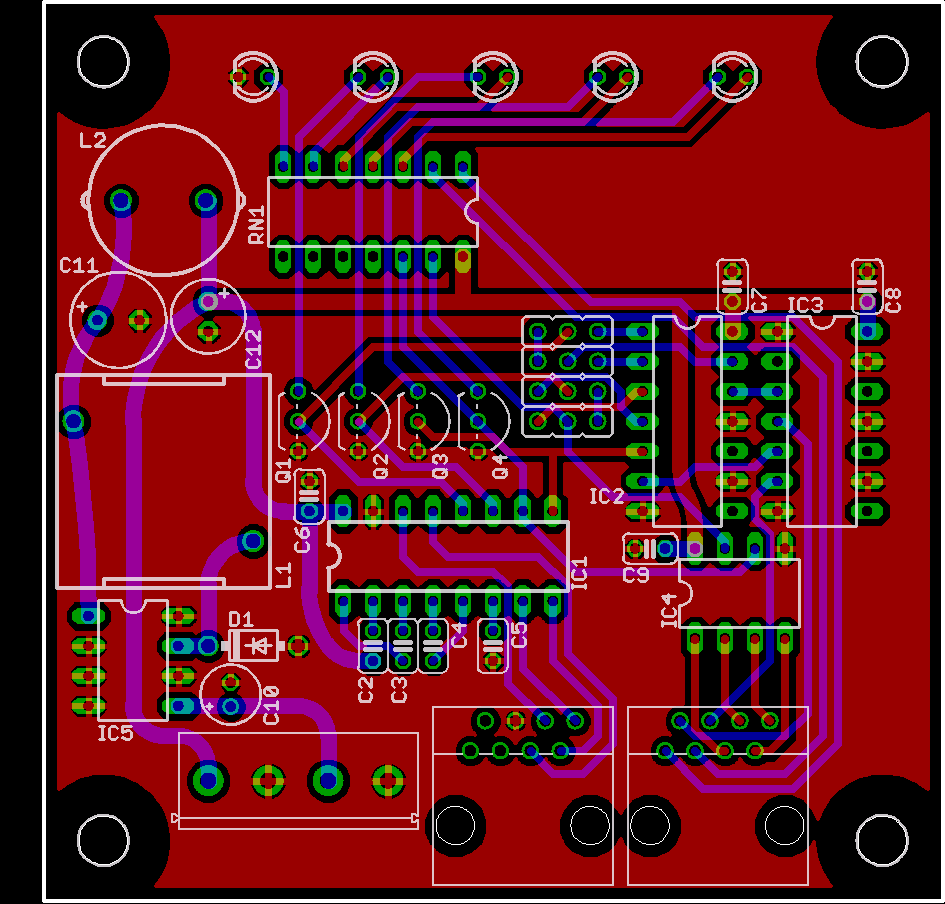
I had to learn a bit more about how the driver works and thusly redraw parts of the PCB, but I think it’s all sorted out now. If you’d like to see the board layout, just take a look here. Of course, you’re also welcome to read through the nuxx Audio Input Switch page, which currently has a fair bit of misplaced / inaccurate information in it.

electronicsmaking thingsmoved from livejournal

PCB Layout

Here, have a PCB layout that I think it almost complete. I need to validate some parts and be sure the drivers work as I expect, but beyond that it should be all set.

Now I’ll be able to switch inputs on a headphone amp without plugging / unplugging things. Yay!

electronicsmaking thingsmoved from livejournal

Audio Input Switch

Yay! I just finished porting the software for my PIC-based audio input switch to the PIC16F630. Earlier this afternoon I got it feature-complete and worked out all the bugs I could find, then in the last half hour or so I got it running on the new chip.

Tonight I hope to get it working with internal pullups (should be trivial) and then I’ll give the power supply design some thought, along with initial parts selection for the PCB itself.

Since I haven’t mentioned it here before, it’s:

– 2-5 input audio selection switch (configurable via jumpers)
– Relays for switching audio
– Fail-safe design
– Switches balanced or unbalanced audio
– Next / Previous buttons
– Mute function
– Saves input to ROM so that last state is restored at power-on
– MIT-licensed software

I’ll post more info later. Now it’s time to go home and meet up with Danielle for dinner.

electronicsmaking thingsmoved from livejournal

Wax On…

My Tent In The Garage, Covered In Nikwax Tent & Gear Proof
(Click for larger…)

My garage and part of my house smell vaguely of white glue, which is what Nikwax Tent & Gear Proof smells like. Since Danielle and I are going camping at Tahquamenon Falls State Park this weekend, and there is the remote possibility of rain (there always is, eh?) I wanted to waterproof my tent. Most of the areas which needed waterproofing were the seams, but I made sure to spray the whole thing down. Also, after letting it sit for a bit and soak in I wiped the whole thing down with a damp cloth, which seemed to do a good job of helping the waterproofing further penetrate the fabric.

After the job was done I tried to wash my hands, but they just became sticky and the water beaded up on them. Neither acetone or denatured alcohol would remove the chemical from my hands, so I took to dry scrubbing them with sodium percarbonate (Oxyclean). This seemed to do a good job, and then soap was able to remove the remaining slick C2H6Na4O12 residue. My hands still feel like they have a bit of the waterproofing compound left in them. Hopefully it’ll come out in the shower tomorrow.

We had originally thought about taking Danielle’s larger tent (see them both here), but we only had one 500mL bottle of waterproofing and the rainfly on hers seems to have a greater surface area than my whole tent. I’m glad I didn’t try waterproofing hers…

Hopefully the weather will cooperate. We’ll have the air mattress to sleep on, sheets and blankets, and (with any luck) a dry weekend.

making thingsmoved from livejournaloutdoors

Maglite LED Upgrade Module

Incandescent vs. LED Lamp in Two D-cell Maglite

I’ve been wanting an LED flashlight for a while, and yesterday when Danielle and I were at REI I saw that Maglite offers LED upgrade modules for their existing flashlights. Years ago when I was in Civil Air Patrol I had acquired a two D-cell Maglite for various encampment / search and rescue / utility purposes. Despite its age (and wear, including being thrown at someone as they ducked into a fire escape) it still worked great, so I figured that a new LED bulb for it would work out great.

While out and about today we stopped by Home Depot and I picked up the Maglite LED Upgrade Module (Model SH32DCW6J, Part 108-000-701), which is advertised as being fitted with a three watt LED. A bit of research showed this to be a Luxeon 3W LED, presumably part number LXHL-PW09.

The lamp itself had no problems fitting into the flashlight just like the incandescent lamp. Once it was installed I shined it around the basement with the lights on and I wasn’t completely sure that it was brighter, but one look at the comparison photos taken in the dark showed that the LED is quite a bit brighter. (I tried to keep the focus as similar as possible on those two, and both were shot at ISO 100, f/11, with a one-second exposure. Locations for the tripod and flashlight were both marked with tape for consistency between shots.)

The part cost US$18.97, but I figure this is worthwhile. It should also help save on batteries. I’m not sure if the LED is being powered in a way which allows the LED to dissipate a full 3W (probably depends on the circuitry in the bulb housing, but it still seems pretty good. Hopefully this will come in handy while camping next weekend.

acquired thingsmaking thingsmoved from livejournal

Alien DAC: Built

Assembled Alien DAC w/USB Power (Top)
(Click for more photos…)

I decided that I’m going to build another one of those Millett Hybrid Maxed headphone amplifiers, except this time I want to build one using a bit more specialized parts, stick it in a case with wooden end panels, and fit both a USB audio adapter and input switch in the housing. As you can see here, the two PCBs will easily fit in the case. (The Elna RFS / Silmic II capacitors can also be seen there.)

Today the Alien DAC kit arrived from Glass Jar Audio, so I set to work putting it together. It really wasn’t too difficult, most of the parts were either through-hole or 1206 / 0805 SMT. The SOT-8 voltage regulators were real easy to solder as well, and I had very little trouble with the SSOP28 PCM2702E. The board is reasonably well laid out, but there are a couple of things I would have changed. I’m really not sure what the designer was thinking (I think he wanted to save space / make things more compact), as hand-soldering SMT IC legs to ground without thermals is a huge pain in the ass. Regardless, it worked out.

Oh, and the bottom of the board can be seen here.

electronicsmaking thingsmoved from livejournal