nuxx.net
Making, baking, and (un-)breaking things in Southeast Michigan.

Millett Hybrid Max is Working

Guess where this is going…
(Click for much larger version…)

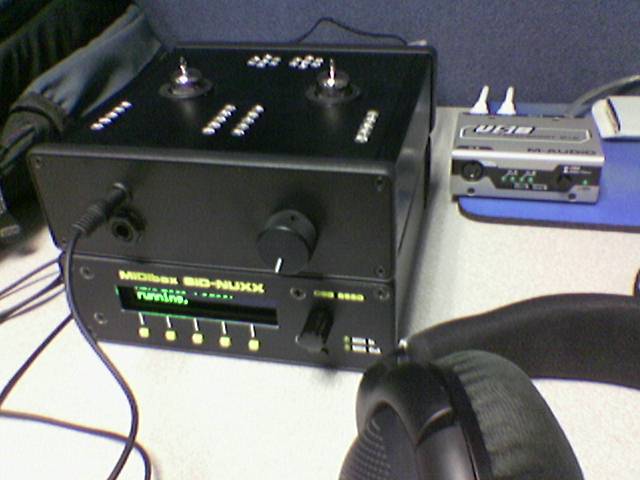
Yep, that’s the (now working) Millett Hybrid Max with recently installed 3.5mm headphone jack, connected to my Sennheiser HD570 headphones and a recently acquired SCPH-1001 Playstation. The amp isn’t set up yet, but I’ve got the problem figured out. Unfortunately I used up ‘s set of MOSFETs in the process due to some misguided advice, so I’ll have to order another set tomorrow.

Want to know what the problem was / is? In short, the designer(s) screwed up. Again. This time it’s with the power supply / fuse requirements.

Click here to read how / why…

electronicsmaking thingsmoved from livejournal

9090 Boards For Sale

Would any of you be interested in buying my 9090 boards (photo gallery retired)?

Asking price is US$550 shipped anywhere within the US. Outside of the US would cost a bit more, but probably not much. This is just slightly more than the cost for all the parts, except the hard work is actually done.

The boards have been professionally assembled and cleaned, then put in storage for a few months as I lost interest in the project. The boards are completely assembled with all parts fitted, it just needs an enclosure.

I’ll grab a few more photos of it tonight, but if you’re reading this you probably know that the work is properly done.

Here is the original page about the 9090.

UPDATE: Sold. :)

acquired thingselectronicsmoved from livejournal

Help with Millet Hybrid Maxed Troubleshooting

(I just posted the following here on the Head-Fi Forums. Hopefully someone there can help me.)

Hey there... This weekend I finished up my Millett Hybrid Max (with MOSFETs) and while it was working great at first (Saturday), I'm now having some problems. I'm hoping that someone here can give me some pointers on where to look.

First off, here are photos of the top and bottom of the PCB: Bottom Low Res, Bottom High Res, Top Low Res, Top High Res.

My soldering is generally pretty good, but please note that all the connections look dull because I'm now using lead-free solder for board work. As can be seen on this page (photo gallery retired) my enclosure is almost exactly the same as cetoole's, including the vent holes for the heatsinks. When it was working the chassis never rose above slightly warm (around 100°F) in a 75°F room, so it seems to be vented well enough.

The power supply is a Jameco-brand 24VAC 1A wall wart. I've used their supplies before and they've been quite good in the past. For fuses I've been using either 800mA or 1A fast-blow fuses. When the amp was working the 800mA was sufficient at levels as high as the maximum I could stand (about 10 o'clock).

Power, audio inputs, and headphone jack are all isolated from the chassis, and their isolation has been confirmed with a continuity meter.

Here's a rough timeline of how the build / testing went and problems I had along the way, which will hopefully help point the way:

- Finished assembling everything, and on powering it on I found only ~2.6VDC from the power supply, regardless of the position of RR3.
- Found that I was bit by the backwards silkscreen on the trimmers, so when I thought I had everything turned down all the way for initial setup it was actually all the way up.
- Properly turned all the trimmers down, powered things on, set the power supply to 27.00 VDC.
- Biased the tubes to 13.50 VDC.
- Biased the MOSFETs to 200mV, which is right in the middle of the range suggested on the MAX Setup and Bias Settings page.
- Hooked up a CD player (random Yamaha changer) and headphones (Sennheiser HD570) and confirmed that I could hear audio.
- Left the CD player playing Radiohead's Kid A on repeat for 4-5 hours with the volume at listening levels.
- Checked the power supply voltage, tube bias, and MOSFET bias and returned them to the settings previously mentioned, as they had drifted slightly.
- Checked the heatsinks with a thermocouple and found them to be around 125°F.
- Listened to a few different CDs and some DVD audio and was happy with the sound.
- The next day I went to hook up my iPod, but I wasn't getting any audio from the left channel. Turned everything off, removed the tubes, looked around, reinserted the tubes, and noted that everything seemed to work.
- Listened to a few more CDs, then found the left channel to be a bit lower than the right. I figured that the MOSFETs needed to be biased again, so I decided to set it aside and open the case the next morning.
- Listening more the left channel started dropping out completely, and during a test while listening to Squarepusher's Tetra-Sync (a 10 minute track) I could hear the left channel fade in and out, and occasionally get a bit static-y / fuzzy.
- The next morning I began thinking the problem might be with the 1/4" to 3.5mm headphone adapter I was using, so I plugged in a different one and turned on the amp. It wasn't working, nor was it warming up.
- Opening up the amp I found that the fuse (800mA) was blown. From this point on it blew every fuse I've inserted.

In testing, I tried the following with no success, with fuses continuing to blow each time:

- Replaced the left tube with a spare NOS 12AE6A.
- Removed the board from the enclosure.
- Replaced both tubes with spare NOS 12FM6 pieces.
- With the tubes in place, VCC to GND is at about 33.8Ω, which just about matches the two tube heaters (~12Ω each) plus R1 (~10Ω). No dead short there.

Any ideas? I'm pretty lost at this point...

Thanks very much...

-Steve

electronicsmaking thingsmoved from livejournal

Headphone Amp

Gur. The headphone amp whice I’ve been working on… isn’t. The damned things just blows fuses. It was working fine one morning, that evening there was crackling fading in/out in the left channel, and the following day it just blew fuses. I didn’t change anything between the days.

It’s not the tubes, as I’ve tried another pair for them.

<sigh>

electronicsmaking thingsmoved from livejournal

Sequentix P3

So, I’m thinking of selling my Sequentix P3.

The main site about it is here.

Strangely, my site talking about mine is the third Google hit when searching for sequentix p3.

I just think the $2k or so that it’ll fetch could do better earning compound interest, or put towards other projects. Maybe a kick-ass second headphone amp or something.

If anyone is interested, please let me know.

acquired thingselectronicsmoved from livejournal

It works…

2006 Honda CR-V Head Unit, Honda Music Link, and Battery Charger

Well, that works. I had no problem supplying the head unit there on ~500mA, and per the meter it only maxed at just about 1.1A on startup. So, I’ve got no idea why the Skynet supply used earlier didn’t work. I’m thinking it was not able to deal with the inrush, so the next thing I’m going to try is to put a switch on the 12V line for the keyed power, starting it up in stages, as is normally done in a car.

That battery charger was only $32 at Meijer, so if I really need to keep it I can, but still… If I do, I’ll probably add some banana jacks to the back or something. At least this stage is almost set and I can get on to building the logic analyzer. Well, only after I get the headphone amp working reliably…

automotiveelectronicsmaking thingsmoved from livejournal

Fuses!

Start of the Honda CD Changer Protocol Test Rig
(Click for bigger image…)

I also can’t seem to power up the car stereo that I have for testing the Honda Music Link stuff. It’s not working. I hear a faint click from the supply as it starts up, then a loud CLICK from the head unit (sounds like the tape deck doing something), then it starts over again. I think it’s not enough power…

That supply is rated for 3A, but I’ve got no idea what the stereo pulls. I figured 3A would be enough, but I’m not sure. I’ve got the keyed and always-on power lines connected at the same time, though, so maybe the inrush current of starting the entire stereo is too much. Maybe I’ll throw a switch on the keyed side of the line and see if that sorts it out. If not, I might just go buy or borrow a car battery charger. That should give a good 10A. If that’s not enough, something in the stereo is likely wrong.

My new amp also keeps blowing fuses, and I’m not sure why. Previously the only time I could make it do this when tubes were pulled, but now it seems to happen with them fitted. It’s frustrating. Either I’ve got misaligned tube holes (they look pretty good) or else something else is wrong. I’m almost tempted to try a different set of tubes.

Part of me is tempted to build a solid state headphone amp (β22 / σ22 combo) and use that instead, but that’d be a lot of work, and I’ve got other projects to do right now. Or maybe I’ll build one of these and use it as a speaker amp with some nice near field monitors in my office. That’d be excellent.

automotiveelectronicsmoved from livejournal

Testing… Testing…

First Tests on my Workbench

Well, it’s working. I’m having a problem with the left channel, but I think it’s actually related to the 1/4″ to 3.5mm adapter I’ve been using and not actually with the amp itself. Also, it sounds really good. Really, really good. I still have to make an iPod cable for it and such, but that’s all on its way.

Last night I was just blown away at how good the DVD Audio version of The Downward Spiral is. Even with some crap RCA cables connected between it and the amp I was hearing things I’d never heard before in all the years I listened to it.

I might have to pick up some more DualDisc titles to feed to the OPPO DV-970HD (photo gallery retired).

electronicsmoved from livejournalmusic

Moo-zick.

I think I was just listening to the DVD audio version of The Downward Spiral a bit too loud. However, the DAC in the OPPO DV-970HD (photo gallery retired) sounds really good, and the remastered, higher bitrate DVD audio version is shiny. I might also pick up a Playstation for music too.

acquired thingsmoved from livejournalmusic