nuxx.net
Making, baking, and (un-)breaking things in Southeast Michigan.

Fudge Ripple

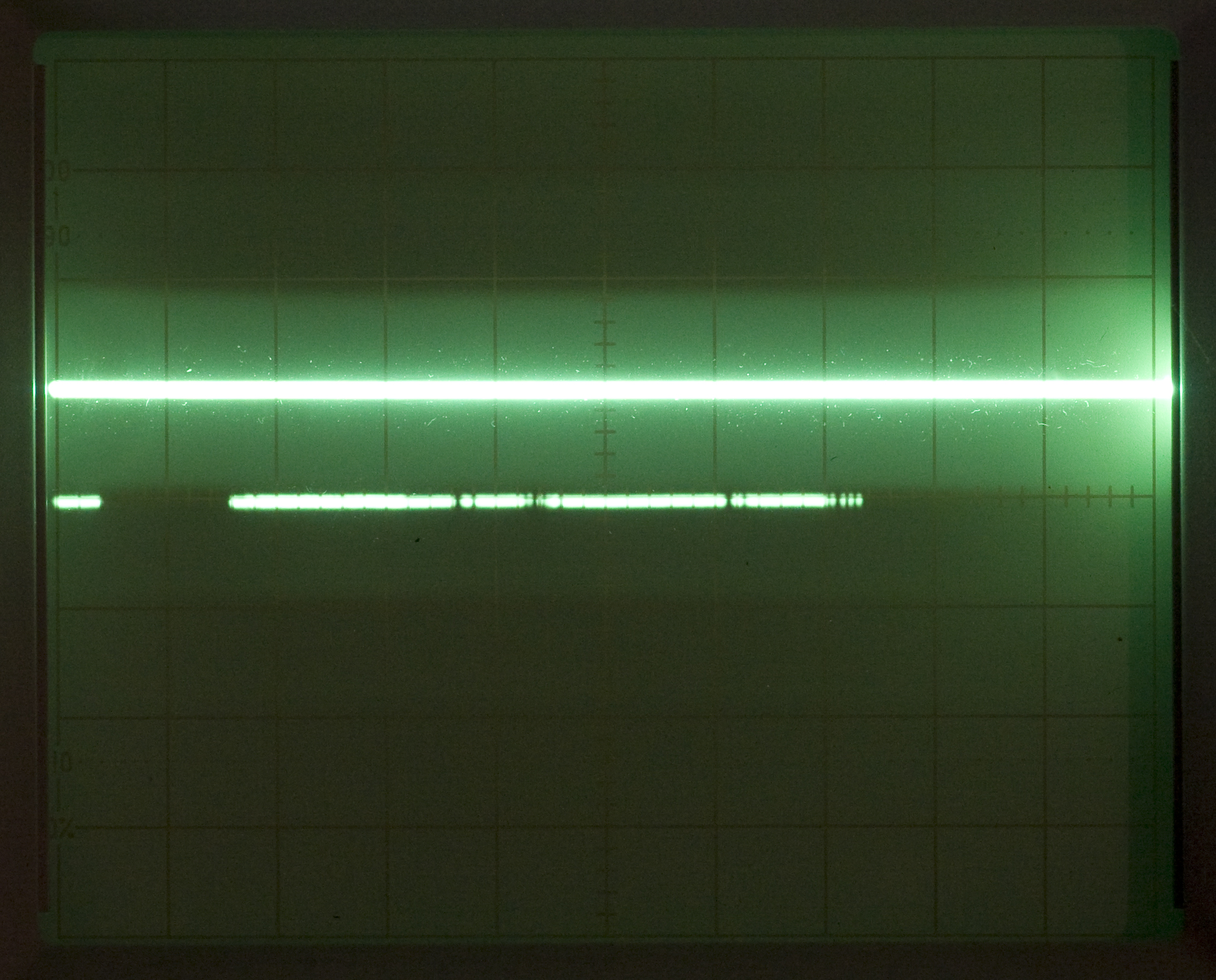
That’s the AC ripple from the power supply mentioned here, when connected to a 10 ohm 10% 10W power resistor, sinking ~490mA. The scope is set at 10mV and 5uS per division, probe at 1x, AC mode. In that image it’s being fed about 36VDC. Cutting that in half using only half the power supply (about 18VDC or so) gives this waveform, with marginally less noise.

The way I see that, peak to peak noise is about 50mV, so just about 1%. I think RMS would actually be a good bit lower, but my scope won’t figure that out for me and I think it’d be a lot of work to do it by hand. So, I think this should be an okay design… This is also on a breadboard, and something well laid out actually with a groundplane and all should be even better.

I might head downstairs and pull out the second filter (inductor + capacitor) and see how much more noise it adds, but I’m fairly certain that it’ll be quite substantial.

One thing is for certain, I really could use a better scope. I’m very tempted to just buy a refurb, $547 Tek 1002. However, I think I’d really rather have one of the B models, which adds serial and USB ports for getting data (screenshots, etc) right out of the scope.

electronicsmoved from livejournal

Cider

There. 5 gallons of unpasturized, unpreserved Rochester Cider Mill cider has been put to ferment. In with the juice is two pounds of honey from Honeyflow Farm in Dryden, MI, two pounds of Domino Dark Brown (Cane) Sugar, and one packet of Lalvin D47 yest.

With an original gravity (density) of 1.082~1.084, this cider will hopefully be around 7% – 8.5% when it is done.

beermoved from livejournal

RS232 to Eaton Leonard Interface, 24V Version, First Draft

Remember those RS232 to Eaton Leonard adapters I made a few months back? Well, there’s a need for me to develop a version which can run from 24VDC, so I did. The switching power supply mentioned a few days back is used in this (you can see its footprint there on the left), with the rest being the same as the other board.

I had to remove the reverse voltage protection (it just won’t really work with the high potential input voltage this needs), I’m using a resistor network instead of discreet resistors to make assembly easier, selected different LEDs (ones that use slightly higher current to go with the 120R network), and laid out the whole board again.

That picture up above is missing the documentation and logo layers, just to obfuscate things a bit. I may also tweak a little bit of the design, but I think I’m happy with it. It’s now 3″ x 3″ instead of the original 3″ x 2″, but that extra three square inches is needed for the power supply. Yes, there’s a bit of blank space still, but I don’t think it’s enough to make shrinking the board worthwhile. The cost difference between the previous PCBs and these is pretty much nonexistant, if I’m remembering the quote right.

I think I’m going to keep compacting the board. Hmm…

UPDATE: I just shaved a square inch off the board by bringing the top in 1/4″. LEDs were compacted a bit, logo made smaller, L2 moved, and more.

electronicsmaking thingsmoved from livejournal

Electronics Stuff

Gah. I just blew (or just noticed that I blew) the 440mA fuse in my DMM. Mouser carries the part but it costs US$22! Grainger carries it for US$8.65

I was able to stop at Radio Shack on the way home and get some 10W power resistors for testing the power supply. I’m having no problems getting about 490mA out of it, which is more than enough for its intended application. Unfortunately the resistors get fairly hot when sinking that much current, so I can’t run them for too long.

Still, things are good with that… I guess I’ll finish part footprint validation and get on with laying out the board.

electronicsmoved from livejournal

Switching Power Supply

Well, the prototype power 5V switching power supply that I cobbled together seems to be working. Up there you can see it powering the first nuxx Audio Input Switch, just to give it some sort of load to work on.

Here is a photo of the bottom of it. It’s clearly hacked together, just sort of built up on the board so I could have solder connections and reasonably short wires. When I tried to breadboard it things didn’t work quite right, which I blame on switching power supplies being touchy about long rows of bare wire.

It’s pretty much a reference implementation (some variances in parts) and it produces what appears to be nice, clean power. I can’t see any noise on my scope. Granted, my scope is pretty crappy, but it does seem to show some noise when it exists. (I can’t afford a new scope yet…)

I’m happy with how it is working thus far. I need to put a bit more load on it, but that’ll be done over one of the next random couple of days. For now I can say that it had no problem giving me an even 5.000 VDC while powering the nAIS above and being fed 6.073 VDC. If I cranked the input up to 35.93 VDC (the highest I can get my benchtop power supply) the power supply was pushing out 5.074 VDC. Pretty good, I think.

electronicsmaking thingsmoved from livejournal

TV-B-Gone

Danielle’s TV-B-Gone
(Click for full res photo…)

Tonight I helped Danielle put together her first electronics kit, one of Limor Fried’s open-source TV-B-Gone kits. She’s soldered a bunch of stuff before from when she briefly went to Kettering, but this is the first functional kit. And, of course, it works!

Well, it at least turns off my TV almost instantly… I imagine that it’ll work pretty well on whatever other ones. At $20 it’s a good, and useful first kit… Imagine actually being able to turn off all those annoying TVs in places like the doctor’s office waiting room, school hallways, and (hopefully) the advertising things on gas pumps.

electronicsmaking thingsmoved from livejournal

On The Edge

Well, after a few months of on again, off again, waiting for carryout, eating lunch, toilet, and bathtub reading I finished On The Edge: The Spectacular Rise and Fall of Commodore.

It’s quite worth reading if you have an interest in the history of Commodore / Amiga and are curious about where things went wrong. It assumes a fair bit about ones’ technical knowledge, just diving in and occasionally talking about how / why some decision or another was bad, but it’s pretty easy to read.

computersfound thingsmoved from livejournal

OS X 10.5

So… 10.5.

To start: Finder no longer sucks. I’m copying 85,000 files (old maildir archive) and it’s behaving as one would expect.

I’m having some weirdness sending photos over from my phone via Bluetooth. Not sure what is to blame yet.

New Terminal is interesting. Not sure if I prefer it or iTerm more, but the concept of building profiles which affect everything the old terminal could do is great.

Mail.app 3.0 seems nice. We’ll see how it does incorporating my old mail.

Stacks are excellent, particularly when /Applications is added as one.

Uhm… More later. Right now I’m particularly waiting for my music library to start copying back so I have stuff to listen to.

computersmoved from livejournal