A Bicycle Troubleshooting Process Example
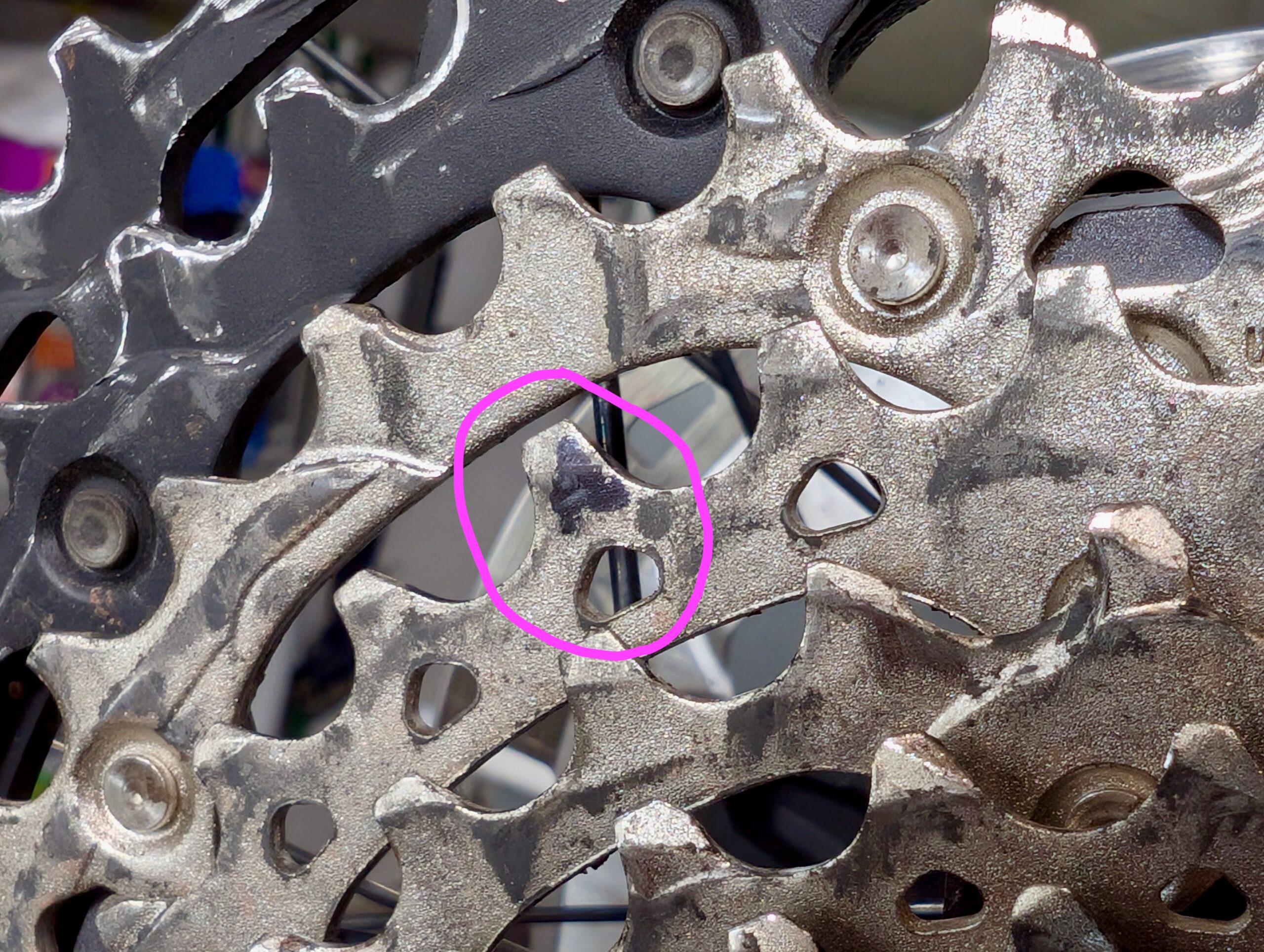
I like troubleshooting things. It’s basically what I do at my day job, and I’m kinda good at it. Sometimes I’m asked for illustrations of how I troubleshoot stuff, so I’m sharing this example of figuring out a noise on my Pivot Trail 429‘s cassette that cropped up yesterday when riding at Poto with some friends.
I visualize this sort of troubleshooting as being shaped like a funnel. At first everything’s really broad and big and open, but with each step I (hope to) narrow things further and further until the potential is super narrow and pointing at the actual problem.
When riding last night the noise started out sounding like a shifting problem. I didn’t feel it in the pedals (so it wasn’t ghost shifting), but it was an irritating click noise that seemed to only happen in my most frequently used gear. So, I kept riding, gathering a bit of data, so I could solve it later. Here’s the whole process broken down by question and finding.
Q: What gear does this happen in?
A: Only the fourth from the largest cog.
Clues: Something might be wrong with this cog. Since it doesn’t affect other gears, it’s probably not cable tension (this affects shifting across all cogs). It could be a bent derailleur hanger, but this is a plastic UDH, and the problem didn’t happen when I last rode the bike in June, so it’s probably not that.
The next day I put the bike in the work stand in the basement and got to looking at the problem.
Q: Where is the noise coming from?
A: Cassette/chain.
Clue: This means it’s probably not a jockey wheel / derailleur issue.
Q: Does the problem cog have an even or odd number of teeth?
A: Even.
Note: With an even-toothed cog, teeth always align with inner/outer plates on each revolution. With odd-toothed cogs, they alternate. Therefore on an even-toothed cog you may need to shift around the cassette and back before the issue will reproduce.
Q: Pedaling gently — forward and backward — and looking at the chain, does it jump or skip?
A: No.
Clue: This means it’s probably not a chain / stuck link problem. (Note that this chain is waxed, and it is a mountain bike, so after damp rides stuck links and corrosion can set in quickly.)
Q: When slowly pedaling backwards, does the noise happen?
A: No.
Clue: Must be pedaled forward to repro. This points further to a tooth issue.
Q: Slowly pedal forward, watching the chain links as they mesh with the cassette. Did this happen at a particular tooth?
A: Yes. Mark it with a sharpie.
Clue: Great! Now we know exactly which tooth. This could be the problem…
Q: Does it happen only when that tooth is meshing with an inner or outer plate?
A: Yes, inner.
Clue: This tells me the tooth might be catching on the narrower plate.
Q: Shift a few rings down the cassette to get the chain out of the way, then inspect and feel tooth for barbs/damage.
A: None found.
Clue: Could be a bent/misaligned tooth. If barb/burr/damage was found, that could cause the catching/noise.
Q: Using a straight-edge and your eyes, see if the overall cog is bent at this point.
A: Doesn’t seem to be. But tip of tooth does look a little bit out of line with the others.
Clue: Tooth could have become slightly bent… This can happen with mis-shifts, debris, etc.
Action: Use a flat blade screwdriver braced against the inner part of the smaller cog to gently nudge the tip of this tooth inboard. (Not even enough to be visible.)
Q: Shifting back to this cog, then shifting around a bunch, can the issue be reproduced anymore?
A: Nope! Seems like this sorted it out.
And… that’s it. Of course the issue shouldn’t be considered completely solved until after a test ride, but a simple change eliminating a noise is promising.